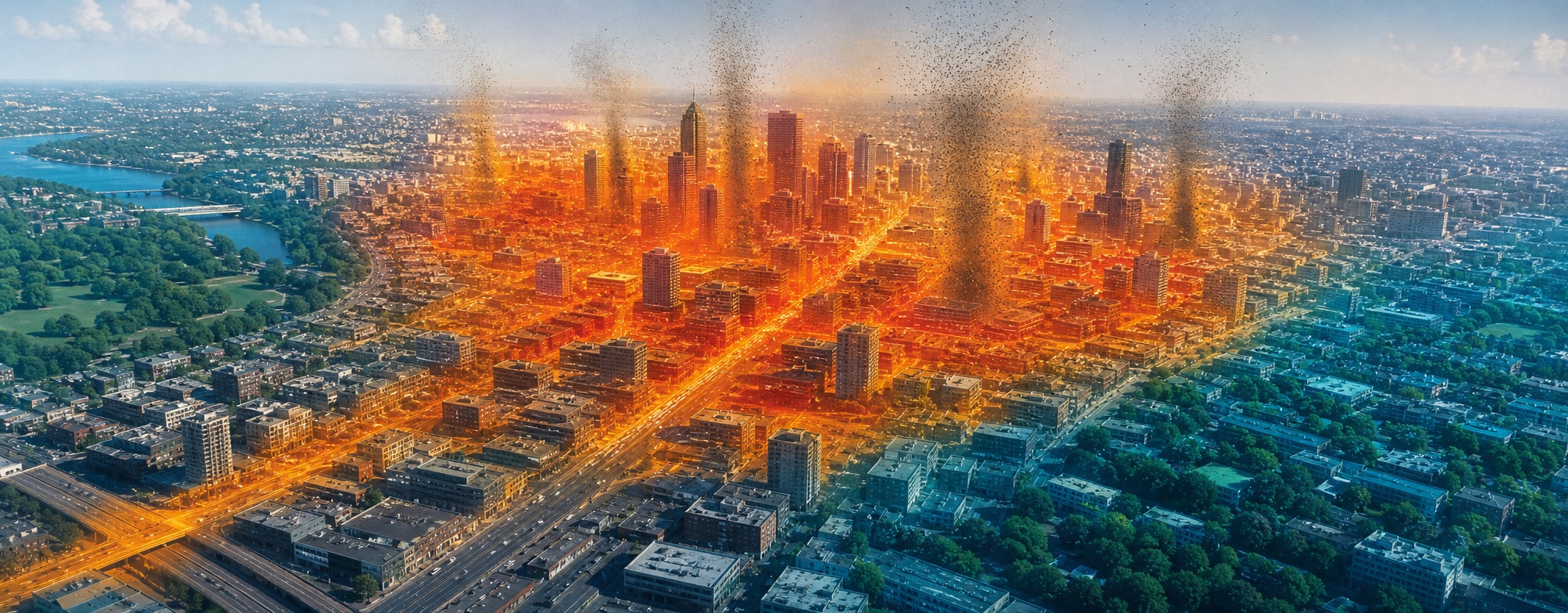
Why Hot Cities Make Air Harder to Breathe
When summer heatwaves settle over concrete jungles, city dwellers face far more than sweltering asphalt and soaring energy bills. Dense metropolitan areas trap heat, creating a microclimate phenomenon known as the Urban Heat Island (UHI) effect. While higher temperatures are uncomfortable on their own, the physiological danger escalates when extreme heat acts as an atmospheric engine—concentrating fine particulate matter (2.5pm) and accelerating the chemical creation of ground-level ozone (O3) in the very air we breathe.
By four in the afternoon in late July, the parking lots in central Phoenix are hot enough to burn skin on contact. Emergency departments there see contact burns every summer from people who fall on asphalt and cannot get up fast enough. [VERIFY: Arizona Burn Center admissions data] The heat is the story everyone tells about a city like this. The chemistry happening overhead is the one that puts more people in the hospital.
Think of the air you breathe as a room. Not a metaphorical room — an actual volume with a measurable ceiling. Atmospheric scientists call it the mixing layer, the depth of air that churns and turns over and carries what a city emits up and away. Some days that ceiling sits two kilometers up. Some days it drops to a few hundred meters, and the city keeps emitting into a room that has gotten much smaller.
Heat changes what happens inside that room.
Ground-level ozone is not emitted by anything. It is manufactured, in the air, out of nitrogen oxides and volatile organic compounds cooking under sunlight. Raise the temperature and the manufacturing speeds up. Solvents and fuel vapors evaporate more readily. Trees release more isoprene, a reactive compound that feeds the same reaction. And a molecule called peroxyacetyl nitrate, which normally locks nitrogen oxides away and carries them out of the city, becomes thermally unstable in the heat and breaks apart, dumping its cargo back into the local air where it can make more ozone. The reaction accelerates on multiple fronts at once. Atmospheric chemists have a name for this relationship: the climate penalty on ozone. Warming does not merely coincide with worse ozone days. It manufactures them.
What that ozone does to a lung is straightforward and unpleasant. It is a powerful oxidant, and the tissue lining your airways is the first thing it meets. It strips cells, provokes inflammation, tightens the airway. People with asthma feel it within hours. So do outdoor workers, endurance athletes, and anyone whose lungs are already working harder than they should — which, on a 45-degree afternoon, is nearly everyone. Madrid restricts traffic in its centre when ozone climbs. [VERIFY: current Madrid ozone protocol thresholds and triggers]
Fine particulate matter is a different problem with a murkier relationship to heat, and this is where the popular version of the story tends to overreach.
PM2.5 is small enough to reach the alveoli, the deepest air sacs, where the lung has no mechanism to clear it. The systemic consequences are well established: inflammatory signaling that reaches the cardiovascular system, elevated risk of heart attack and stroke in the days after exposure. The common claim that these particles cross wholesale into the bloodstream overstates what the evidence shows. That translocation has been demonstrated mainly for ultrafine particles, an order of magnitude smaller. The damage from PM2.5 is real without it.
But heat does not reliably trap PM2.5 the way most articles suggest. The stagnant conditions that concentrate particulates come from the high-pressure systems that also produce heat domes, sinking air that caps the city and kills the wind. The heat island itself often works the other way, keeping the air over a city warm and unstable at night when the surrounding countryside has cooled and settled. The ceiling over a hot city can be higher, not lower. What actually drives the worst particulate days during modern heat events, increasingly, is smoke. The same conditions that bake a city also cure the fuel that burns upwind of it.
So the intervention list gets more complicated than it looks.
Reflective roofs lower surface temperatures and cut air-conditioning demand, and the evidence for that is solid. They also reduce the surface heating that drives vertical mixing, which in some modeling work slightly lowers the mixing height and offsets part of the air quality benefit. [VERIFY: cool roof mixing height literature — Georgescu, Millstein] Tree canopy cools reliably and well, but planting the wrong species raises isoprene emissions in exactly the places where ozone is already forming, and a dense canopy over a narrow street canyon can hold traffic exhaust at the level where people are standing. Neither finding is an argument against shade or reflective surfaces. Both are arguments against doing it carelessly.
Ahmedabad learned the sequencing after a 2010 heatwave killed an estimated 1,300 people. The city built South Asia’s first heat action plan: colour-coded warnings, hospital preparation, water distribution, shifted work hours, a long-term canopy and cool-roof program running underneath. The plan starts with keeping people alive this week. The infrastructure is the part that takes twenty years.
Are you noticing unexplained fatigue or respiratory tightness on high-heat days? Log your symptoms in SharedSky today to start mapping your personal environmental baseline.