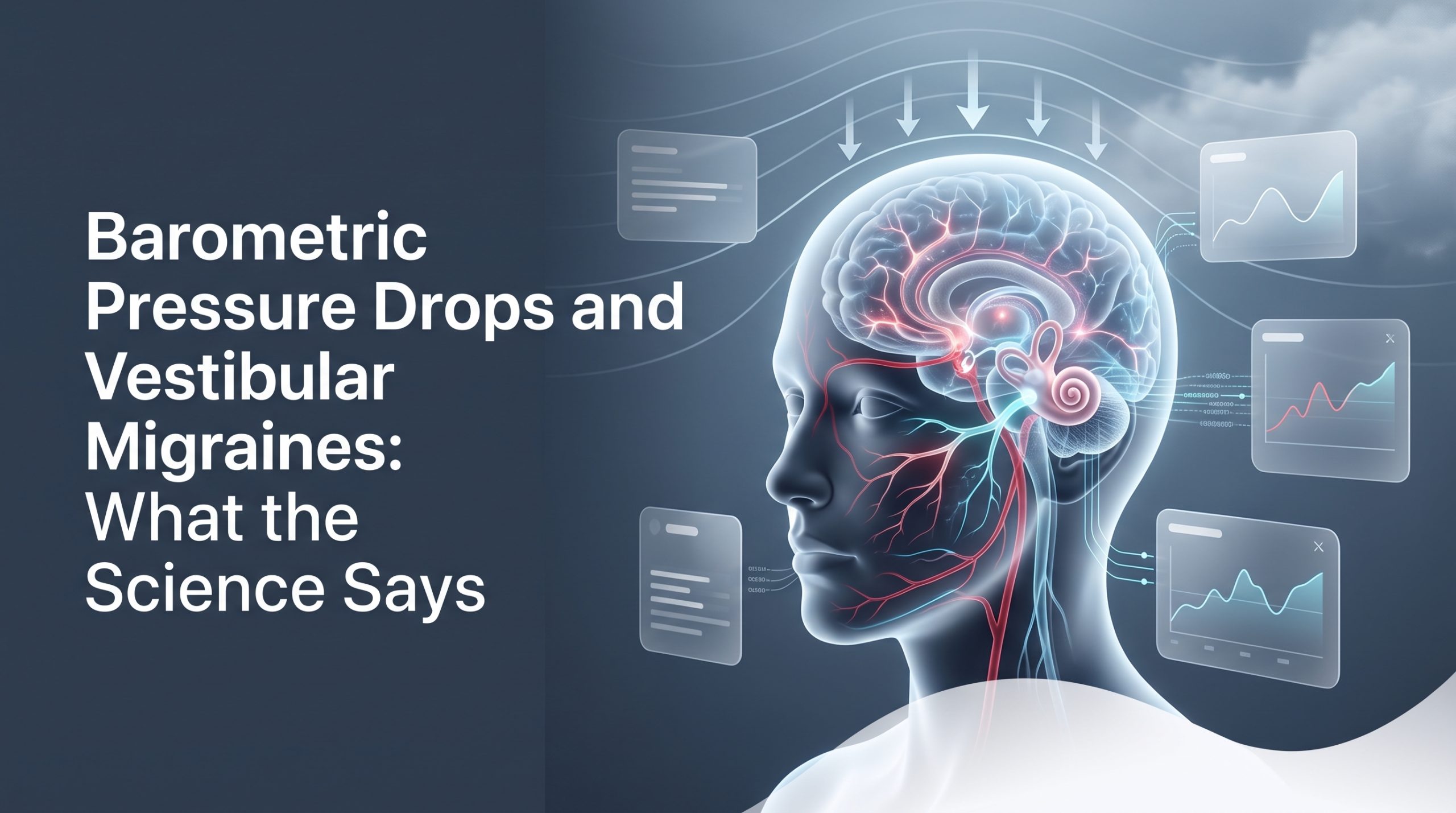
What the Science Says
For millions of individuals living with migraine conditions, a darkening sky is more than a signal to grab an umbrella—it is a physical warning. Weather-related headaches are frequently dismissed as anecdotal or coincidental. However, growing neuro-biological research confirms a direct connection between rapid barometric pressure drops and acute vestibular migraine episodes.
Understanding how atmospheric shifts alter intracranial dynamics, activate cranial nerves, and trigger vascular constriction is essential for managing weather-induced sensitivity. By examining the underlying physics and biological mechanisms, individuals can transform unpredictable weather shifts into trackable, manageable health patterns.
The Physics of Barometric Pressure and Body Cavities
Barometric pressure (also known as atmospheric pressure) represents the weight of the air pressing down on the Earth’s surface. Under stable weather conditions, the external air pressure balances seamlessly with the fluid and gas pressures inside the human body.
When a cold front, thunderstorm, or low-pressure system approaches, atmospheric pressure drops rapidly. This sudden decrease in external force creates an immediate pressure differential between the outside environment and the air-filled cavities within the human head—specifically the paranasal sinuses, middle ear chambers, and vascular networks.
STABLE WEATHER (BALANCED)             LOW-PRESSURE FRONT (PRESSURE DROP)
   External Air Pressure                 Decreased External Pressure
          │     │                                  │     │
          ▼     ▼                                  ▼     ▼
    ┌─────────────┐                            ┌─────────────┐
    │ Sinus / Ear │                            │ Sinus / Ear │  ◄── Internal Expansion
    │  Cavities   │                            │  Cavities   │      & Tissuue Tension
    └─────────────┘                            └─────────────┘
As external pressure falls, gases within the sinus cavities expand slightly against surrounding bony walls and mucosal membranes. In sensitive individuals, this mechanical expansion exerts localized pressure on micro-vessels and sensory nerve endings, setting off a cascade of neurological events.
Biological Pathways: Cranial Nerves, Vascular Shift, and Vestibular Activation
The transition from a simple atmospheric pressure drop to a full-blown vestibular migraine involves three main physiological pathways:
1. Trigeminovascular System Activation
The trigeminal nerve (Cranial Nerve V) is the primary sensory pathway for the head and face, supplying nerve fibers to the sinus linings, scalp, and major cranial blood vessels. Mechanical stress caused by expanding sinus gases directly stimulates trigeminal nerve endings.
Upon stimulation, the trigeminal nerve releases vasoactive neuropeptides—including Calcitonin Gene-Related Peptide (CGRP) and Substance P. These compounds cause rapid neurogenic inflammation, leading to dilation and sensitization of cranial blood vessels. This vascular shift manifests as the classic throbbing pain of a migraine episode.
2. Vestibular System Disturbance
Unlike standard tension headaches, vestibular migraines are characterized by prominent balance disturbances: vertigo, dizziness, motion sensitivity, and spatial disorientation. The inner ear contains the vestibular apparatus—a series of fluid-filled canals (endolymph and perilymph) responsible for balance.
Rapid drops in ambient barometric pressure disrupt the pressure equilibrium between the middle ear cavity and the inner ear fluid systems. This pressure gradient alters the mechanical movement of sensory hair cells within the semicircular canals, sending distorted spatial signals to the brainstem. For individuals with hyper-excitable central nervous systems, these conflicting inputs trigger acute vestibular dizziness and nausea.
3. Serotonin and Vascular Constriction
Atmospheric changes also impact central neurotransmitter regulation. Drops in barometric pressure trigger rapid fluctuations in systemic serotonin (5-HT) levels. An initial spike in serotonin causes cerebral blood vessels to constrict, temporarily reducing blood flow to specific brain regions. As serotonin levels subsequently plunge, cranial blood vessels rebound into rapid dilation, worsening perivascular inflammation and neural hypersensitivity.
Recognizing the Vestibular Migraine Symptom Profile
Weather-induced vestibular migraines present differently from traditional aura-based headaches. Symptoms often begin hours before rain or a weather front physically arrives, matching the initial atmospheric pressure decline:
SENSORY & BALANCE SYMPTOMS
Spatial Disorientation and Vertigo: A sensation of spinning, swaying, or floating, often exacerbated by minor head movements.
PAIN & PRESSURE SYMPTOMS
Fullness and Sinus Tension: A feeling of deep pressure behind the eyes, forehead, or ears, frequently mistaken for sinus infections.
NEUROLOGICAL SENSITIVITIES
Photophobia and Auditory Sensitivity: Heightened vulnerability to bright light, environmental noise, and motion sickness during low-pressure windows.
Building Your Personal Sensitivity Baseline: A Step-by-Step Guide
Because weather patterns are outside individual control, preventing weather-induced migraines relies on forecasting, personal awareness, and early intervention. Logging daily health symptoms alongside local atmospheric data allows you to identify your exact pressure sensitivity threshold.
Follow this step-by-step approach to map your environmental triggers using SharedSky:
Step 1: Establish a Consistent Daily Logging Routine
Log your physical state once or twice daily in the SharedSky app—even on days when you feel completely healthy. Record baseline metrics like head pressure, balance stability, fatigue, and energy levels. Logging healthy days is necessary for determining what environmental metrics your body tolerates comfortably.
Step 2: Automated Meteorological Correlation
When you log an entry, SharedSky automatically captures local weather variables, including current barometric pressure (hPa/inHg), 6-hour pressure trends, relative humidity, temperature, and local ambient air pollutants (2.5pm and ground-level ozone).
USER LOG: "Mild Dizziness & Sinus Pressure"
                      │
                      ▼
AUTOMATED METRIC SYNC: [ Pressure: 1004 hPa (──► -8 hPa Drop over 4 hrs) ]
                       [ Pollutants: 2.5pm Low | Humidity: 82%          ]
Step 3: Identify Your Personal Delta Threshold
Migraines are rarely triggered by static low pressure alone; rather, they are precipitated by the rate of change (the delta). After 14 to 21 days of logging, review your personal trend charts in SharedSky. Look for patterns where symptom onset correlates with specific drops—such as a decline exceeding 4 hPa within a 6-hour window.
Step 4: Account for Cumulative Environmental Load
Barometric pressure drops often act as the tipping point when combined with other environmental stressors. Use your trend data to see if pressure drops trigger migraines primarily when 2.5pm air pollution or pollen counts are also elevated.
Step 5: Implement Proactive Measures
Once you know your sensitivity threshold, set custom pressure-drop alerts in SharedSky. When a incoming low-pressure front is detected, take proactive steps: prioritize hydration, maintain steady sleep schedules, limit indoor sensory strain, and discuss preventive treatments with your healthcare provider.
Transforming Environmental Data into Health Clarity
Weather-induced migraines are grounded in measurable human physiology. By understanding how barometric pressure drops impact cranial nerves and inner ear dynamics, you can take control of your well-being. Tracking your daily health alongside environmental shifts turns unpredictable weather changes into structured, actionable insights.
Ready to uncover your weather sensitivity thresholds? Start logging your daily baseline with SharedSky today.