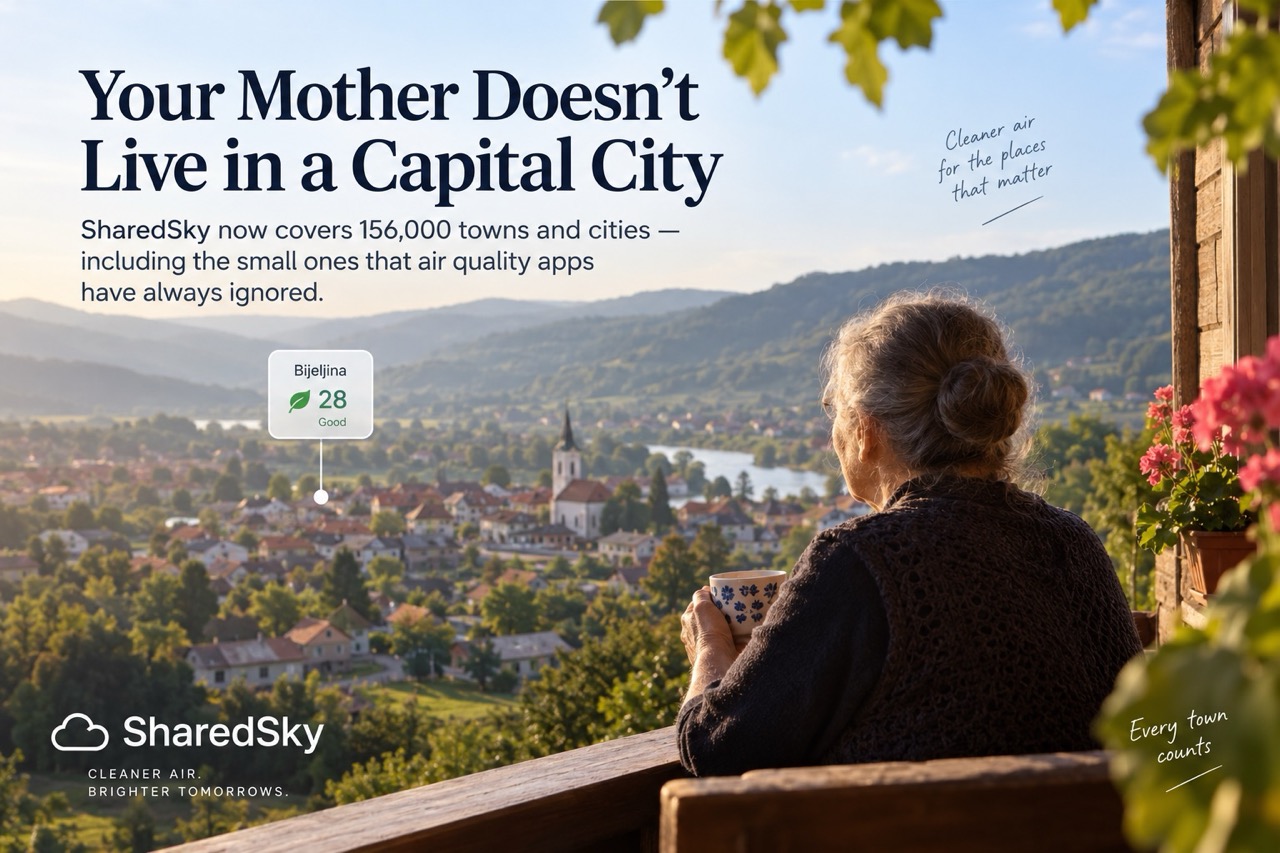
SharedSky now covers 156,000 towns and cities — including the small ones that air quality apps have always ignored.
If you have ever tried to check the air quality where your parents live, you may have run into the same wall twice.
The first time, you open a weather or air quality app, type in the name of their town, and get nothing. No results. The app knows Belgrade, Zagreb, Sarajevo. It does not know Bijeljina, or Užice, or Bar.
The second time, you widen the search and settle for the nearest big city — sixty kilometres away, on the other side of a mountain, in a different valley with a different wind. The app gives you a number. The number is confidently wrong.
We have spent the last few months fixing this. SharedSky now covers 156,000 towns and cities worldwide — every settlement with more than a thousand residents. If your parents live somewhere with a post office and a bus stop, we almost certainly have it.
Why small towns were left out
Air quality monitoring was built for cities. Ground stations are expensive to install and maintain, so they get placed where the most people are, and where the regulatory pressure is. A country might have thirty official monitoring stations for eight million people, nearly all of them clustered in three or four urban centres.
Apps inherited that geography. If there is no station, there is no reading, and if there is no reading, the town simply does not appear in the search box.
The problem is that this gets the need exactly backwards.
The air is often worse in the small places
There is a widespread assumption that small towns have cleaner air than cities. Less traffic, fewer people, more trees. Often that assumption is wrong, and in this region it is wrong in a specific and predictable way.
Many towns in the Western Balkans sit in valleys. In winter, cold air settles in the valley floor and warmer air sits on top of it — a temperature inversion — and the lid stays on for days. Underneath that lid, thousands of households are burning wood and coal for heat. The smoke has nowhere to go.
The result is that during winter, small industrial and valley towns across the region routinely record particulate levels that would make headlines in a Western European capital. They do not make headlines here, because in most of these towns nobody is measuring, and the people breathing it have no way to know today is worse than yesterday.
How we cover places without a monitoring station
We do not invent readings, and we do not pretend a distant station’s numbers are local.
SharedSky uses atmospheric modelling from the Copernicus Atmosphere Monitoring Service, the European Union’s earth observation programme. CAMS combines satellite observations, ground stations where they exist, and physical models of how air actually moves, then produces estimates on a grid that covers the whole continent — not just the places with equipment on the ground.
This is genuinely different from a measured reading, and we think it is worth being clear about the difference. A ground station tells you what the air was like at one specific point. A model tells you what the air is most likely doing across an area, based on everything known about the sources, the terrain, and the weather. For a town in a valley with no station, the model is not a second-best option. It is the only option, and it is a good one.
Pollen and pressure work the same way. Alongside air quality, SharedSky tracks birch, grass, olive, ragweed and other pollen types, plus barometric pressure and heat conditions — all on the same grid, all for the same 156,000 locations.
Finding a town that isn’t spelled the way you spell it
Coverage is not only a question of how many places are in the database. It is also whether people can find them.
Places in this region are written several ways. Пожаревац and Požarevac are the same town. Someone typing on a phone in a hurry writes Pozarevac without the diacritics. A German caregiver looking up a Polish town types Danzig, not Gdańsk. A French user searching for a town in Serbia may not have Cyrillic on their keyboard at all.
SharedSky searches across all of these. Type it in Cyrillic or Latin, with the diacritics or without, in the local name or the name your language uses — the town comes up. This matters more than it sounds like it should, because the moment a search returns nothing, people conclude the app does not cover their area and they close it.
What this is for
SharedSky exists to answer one question: is it just me, or is it the air today?
That question comes up most often for people who are older, who have asthma or COPD or arthritis or migraines, and who notice on some mornings that breathing is harder or the joints ache more, without knowing why. Sometimes the reason is the air. Sometimes it isn’t. Knowing which is true is useful — it tells you whether to keep the windows closed and skip the walk, or whether something else is going on and it is worth mentioning to a doctor.
And it is often not the person themselves who goes looking for that answer. It is a son or daughter in another city, or another country, trying to make one small thing about a parent’s day slightly more manageable. If you are that person, you can install SharedSky on their phone in about thirty seconds, and they will never need to type anything again.
Their town is in there now.
SharedSky provides environmental information and is not a medical device. It cannot diagnose conditions or replace advice from a healthcare professional. If symptoms are severe, persistent, or new, contact a doctor.
Environmental data: Copernicus Atmosphere Monitoring Service, Open-Meteo. Location data: GeoNames.